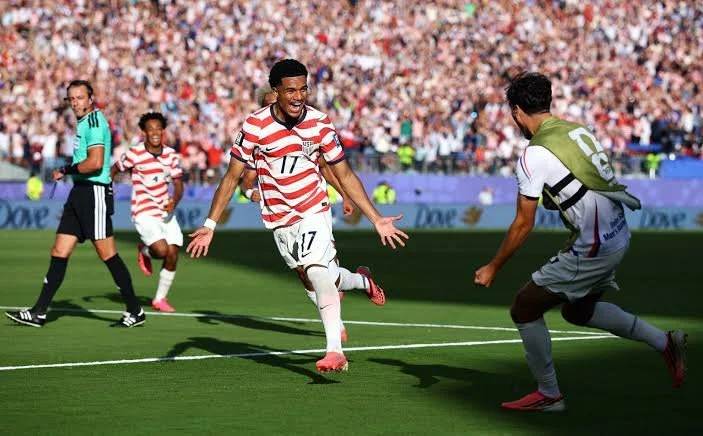
How MLS and the NWSL are turning a one-month spike in attention into a multi-year commercial runway — and what that playbook means for any property or brand chasing a tentpole moment.
By Sterling Mack · Sports Tech Atlanta
Every four years, American soccer gets handed a gift it has historically struggled to keep: a flood of new attention that arrives with the World Cup and, more often than not, leaves with it. This cycle, the two biggest U.S. leagues are treating that flood less like a celebration and more like a customer-acquisition event — because that's exactly what it is.
The setup is favorable. Even now, only about a quarter of U.S. consumers call themselves soccer fans, but well over a third say they expect their interest in the sport to climb, according to Nielsen data cited by Marketing Dive. That gap — between who's a fan today and who's about to become one — is the entire opportunity. And it's a gap that closes for whoever is positioned to catch the fan on the way down the funnel, not just the property with the biggest logo on tournament day.
Positioning as the "next stop"
Both Major League Soccer and the National Women's Soccer League have landed on the same core message, framed slightly differently: the World Cup ends, we don't. Same players, same pitches, same sport — just a league you can follow every week once the global tournament packs up.
MLS is backing that message with what it describes as its first enterprise-wide campaign, with the league and its clubs going to market together across paid media, creators, and experiential — and syncing with Fox's local broadcast affiliates. That "go together or don't break through" logic is worth underlining. In the most crowded soccer-attention market the U.S. has ever seen, fragmented activation gets drowned out. Alignment is the strategy.
The timing is deliberate, too. MLS returns from its summer pause just ahead of the final, then rolls straight into all-star week, the Leagues Cup crossover with Liga MX, and a sprint season in early 2027 as it shifts its calendar toward the European model. The World Cup isn't the finish line for that campaign — it's the on-ramp to two straight years of momentum.
The NWSL is playing an even longer game. Its "Summer of Soccer" push — anchored by a branded road-trip bus hitting league markets and major soccer destinations through the summer — is explicitly framed as the opening move in a five-year build toward the 2031 Women's World Cup, which the U.S. will help host. Sitting at the intersection of two of the fastest-growing narratives in sports — women's sports and soccer — the league wants to be the obvious destination for fandom that spills out of every global tournament between now and then.
Creators are the new top of the funnel
The most instructive shift, from a commercial standpoint, is where both leagues expect new fans to come from. The old assumption — someone turns on a broadcast, watches 90 minutes, and emerges a fan — is no longer the primary path. Discovery now starts on the scroll: a clip, a player, a creator talking about the league. MLS's league and club channels reach well over 100 million followers globally, and the league is candid that most new fans meet the sport through creators before they ever watch a full match.
The NWSL's approach to that channel is the part brands should study closest. Its creator strategy isn't built around maximum reach — it's built around fit. The question isn't "who has the biggest audience," it's "who can show up authentically in this space." With the IAB now classifying creator content as a core media channel on track for roughly $44 billion in spend, that distinction — authenticity over raw reach — is the difference between an activation that converts and one that gets scrolled past.
Sponsorship has moved past the logo slap
For the brands writing the checks, the through-line is that placement alone no longer earns its keep. MLS's partner roster runs deep — Adidas, Coca-Cola, P&G, Chevrolet, Allstate, a Walmart-powered creator network, a TikTok partnership, and a newer banking deal with Chime — but the league is explicit that it's chasing partners who bring cultural intent, not just budget. The Chime tie-up gets described as a fit precisely because the brand wants to build the same kind of things the league wants to build.
The NWSL frames it more bluntly: the goal is to create genuine ways in for partners — Tylenol and Yeti on the tour, Ally on rivalry programming, e.l.f. on the Challenge Cup — that move the partner's business, not just decorate the league's. Not a logo slap. Co-built activation that serves both sides.
What this means if you're building
Strip away the scale of MLS and the NWSL and the playbook is portable — and it's the same one we work through with clients at STA:
Treat tentpole moments as acquisition windows, not visibility windows. The value isn't the eyeballs during the event; it's the retention system that catches them after. Build the "next stop" positioning before the moment arrives.
Go to market aligned. A league and its clubs pulling in the same direction cut through where scattered efforts don't. The same holds for a startup and its retail, creator, and platform partners.
Buy authenticity, not reach. Creator fit beats creator size for conversion. The right mid-tier voice in the right space outperforms a bigger name who can't show up organically.
Sell co-built, not co-branded. The sponsorships that renew are the ones engineered to move the partner's business, not just to place a mark on an asset.
Emerging leagues and funded sports startups don't get a World Cup handed to them. But every category has its version of a spike — a launch, a marquee event, a cultural moment — and the discipline is the same: build the bridge from the moment to the next thing first, so the attention has somewhere to go.
The tournament is the easy part. The runway is where the commercial work actually happens.
Sterling Mack is Founder and Managing Director of Sports Tech Atlanta, a commercial development and sports-technology advisory firm. Reporting referenced from Marketing Dive's coverage of MLS and NWSL World Cup marketing (June 2026).