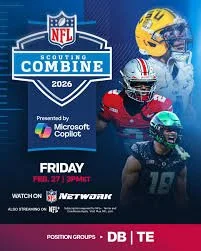
At Sports Tech Atlanta, we’re obsessed with the "bridge"—that sweet spot where elite performance meets cutting-edge innovation. This past week in Indy, the NFL Scouting Combine wasn't just a job interview; it was a high-stakes laboratory. While the headlines are buzzing about Brenen Thompson’s blistering 4.26 forty, the real story is the invisible infrastructure capturing every micro-movement.
The 2026 Combine, presented by Microsoft Copilot, has officially moved us past the era of manual stopwatches and into the age of predictive physics. Here’s the tech breakdown from the floor of Lucas Oil Stadium.
1. Next Gen Stats (NGS) and the "Speed Density" Era
We’ve moved way beyond "fast." This year, the focus shifted to Top Game Speed and Explosive Burst metrics.
Top Speed Tracking: It’s one thing to run a 4.40; it’s another to hit 20.95 mph while weighing 291 pounds. That’s exactly what DT Kaleb Proctor did, instantly vaulting his draft stock by proving his "functional speed" is elite for his size.
The 10-Yard Split Evolution: Scouts are now prioritizing the 10-yard split over the full 40 for linemen and linebackers, using laser-optical sensors to measure the exact millisecond of "initial burn."
2. Spatial Computing and the Digital Twin
The NFL's partnership with Microsoft has brought AI-driven modeling to the forefront. By using "Combine Experience" data, teams are creating digital twins of prospects to simulate how their physical frames (like Rueben Bain Jr.’s much-discussed 31-inch arms) will hold up against veteran NFL tackles.
STA Take: This is the same "Spatial Storytelling" we see in the NBA's latest cloud deals. It’s no longer about a stat sheet; it’s about a 3D profile of an athlete’s potential.
3. Smart Equipment: The 60-MPH Club
The quarterback drills saw some serious heat this year. Using sensor-embedded balls and high-frequency "guns" in the stands, scouts tracked official velocity in real-time.
The Benchmark: Garrett Nussmeier and other top arms were flirting with the 61 mph mark. To put that in perspective, Patrick Mahomes’ in-game peak is around 62 mph. This granular data allows GMs to see if a QB’s "zip" fades after 50 throws—a key indicator of arm endurance.
4. The "Athleticism Score" (RAS 2.0)
The Relative Athletic Score (RAS) has gone mainstream, but in 2026, the NGS Athleticism Score is the gold standard. It’s a proprietary algorithm that weighs height, weight, and every drill result against historical data.
Historical Performance: Oregon TE Kenyon Sadiq didn't just break records with a 4.39 forty; his 95 NGS score confirms he’s a 1-of-1 athletic freak for the position.
The game is getting faster, but the tech is getting smarter.