Robot Umps
Are Real.
And It's Working.
MLB's Automated Ball-Strike Challenge System debuted Opening Day 2026 — and in the first week, it's already flipping games, exposing blown calls, and rewiring baseball strategy.
For decades, arguing balls and strikes got you tossed. Now it gets you answers. The 2026 MLB season officially launched the Automated Ball-Strike (ABS) Challenge System — and just one week in, it has already changed outcomes, exposed umpire tendencies, and injected a brand-new layer of chess into America's pastime.
Opening Night: History Is Made
The ABS system made its long-awaited regular-season debut on March 25th, during the Yankees-Giants opener on Netflix — the first-ever live MLB broadcast on the streaming platform. New York Yankees shortstop José Caballero stepped into history as the first player to initiate an ABS challenge in an MLB regular season game, contesting a Bill Miller strike call in the fourth inning. The call was upheld — a humbling first moment — but the moment itself was monumental.
The following day, Francisco Álvarez of the New York Mets earned the distinction of making the first successful ABS challenge in regular-season history, overturning a ball call on a Freddy Peralta pitch into a strike — sending Oneil Cruz back to the dugout on strikes.
It turned the game around in a sense. It was good to turn that around, get on base and score there. I trust my instincts and discipline at the plate.
— Roman Anthony, Boston Red Sox outfielder
The First-Week Numbers Are Eye-Opening
Just four days into the 2026 regular season, ABS had already produced 124 total challenges across 35 games, with 67 of them — 54% — resulting in overturned calls. That's not a rounding error. That's proof that the balls-and-strikes debate baseball fans have had for generations was entirely justified.
Through the first 12 games, teams posted a 61.3% success rate on challenges, going 19-for-31. The defense — pitchers and catchers — has led the way in both volume and accuracy so far, though those numbers are expected to fluctuate as hitters grow more comfortable reading their zones in real time.
The vast majority of challenges have targeted pitches below the strike zone, which historically has been harder for plate umpires to track from their position behind the catcher. This trend is already shaping how pitching staffs are thinking about pitch location and sequence.
The Technology Behind It
The ABS system isn't a robot behind home plate — it's a sophisticated computer vision architecture layered onto the existing stadium infrastructure. Here's how it actually works.
Hawk-Eye Cameras
Twelve Hawk-Eye cameras are placed around the perimeter of the field to track every pitch's precise location in three-dimensional space. The same system powers MLB's Statcast data that fans and analysts rely on daily.
Sub-Inch Accuracy
MLB officials have stated 95% confidence that ABS reports pitch location to within 0.39 inches, with the median margin of error in 2026 spring training measured at approximately 0.16 inches. That's thinner than a pencil.
Personalized Strike Zones
The ABS zone is 17 inches wide — identical to home plate — with the top boundary set at 53.5% of each player's measured height and the bottom at 27%. Every player's zone is uniquely calibrated.
5G-Powered Replay
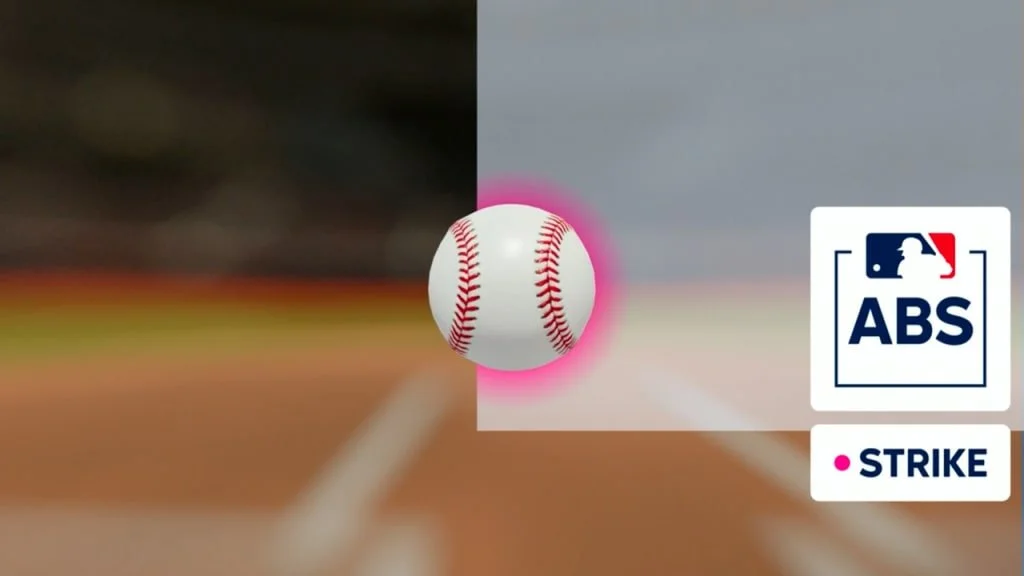
When a challenge is initiated, a graphic showing the result is transmitted over T-Mobile's 5G Advanced Network Solutions and displayed nearly instantaneously on stadium videoboards and TV broadcasts.
How A Challenge Actually Works
Immediately after a pitch is thrown — and with no help from the dugout — the pitcher, catcher, or hitter can challenge a ball or strike call by tapping his helmet or hat. The umpire acknowledges the challenge, and the pitch is replayed in real time via animation on the stadium videoboard and broadcast.
Each team starts the game with two challenges. A successful challenge means the team retains it. Lose two and the ability to challenge is gone for the rest of the regulation game. If a game goes to extra innings, any team out of challenges receives one challenge per extra inning.
The result? A new layer of in-game strategy that front offices, managers, and players are still figuring out. When do you burn a challenge — in the third inning on a borderline pitch, or save it for the ninth with the game on the line?
It feels like it's going to be a frequent occurrence that a team is out of challenges in the eighth and ninth innings and important — maybe the most important — pitches are still going to be missed.
— Anonymous MLB Executive, via ESPN
The Road That Got Us Here
ABS didn't arrive overnight. The independent Atlantic League first experimented with ABS technology during its 2019 All-Star Game, using TrackMan-equipped umpires receiving calls via earpiece. From there, adoption spread steadily through the minor league system.
The Challenge System specifically was first used in the Florida State League in 2022. By 2023 and 2024, Triple-A baseball was testing both full ABS — where every call was automated — and the challenge model. By the end of 2024, the challenge format had emerged as the clear favorite.
Minor League testing revealed a strong preference among fans, players, managers, and other personnel for the challenge system over full automation. The reason: people still want human umpires with feel for the game — they just want a check on the most consequential errors.
According to an MLB poll in 2024, 61% of team personnel (including players) and 47% of fans preferred a challenge system for ball-strike calls, compared to 28% of team personnel who preferred no ABS at all, and just 11% wanting full automation. MLB listened.
What Teams Are Learning — Fast
Strategy is evolving in real time. In spring training, 53% of 1,844 challenges were successful, with batters succeeding 45% of the time versus 60% for the defense — and there were an average of 4.32 challenges per game. Those are the benchmarks teams carried into Opening Day.
But nuance is emerging quickly. Some pitchers, managers note, may not be ideally positioned to judge their own calls. Modern pitchers have more violent follow-throughs than in past eras, meaning they often land falling to one side — with their head going with them — making it difficult to track where the pitch actually landed in the mitt.
And the psychological dynamic is real. Red Sox manager Alex Cora was ejected in one early-season game over strike zone disagreements — and was candid that ABS changes how everyone thinks about confronting umpires: the system makes every call public and visible, creating new accountability for both players and the men in blue.
The Bottom Line
One week in, the ABS Challenge System has passed its first real test. Fans understand it, players are embracing it, managers are strategizing around it, and — most importantly — it's already correcting calls that would have changed games. The technology works. The drama is real. And the debate about ball-and-strike calls, rather than disappearing, has become more interesting than ever.
This isn't robots replacing baseball. It's precision technology giving the sport a tool it should have had years ago. And for Atlanta — a city that's always been at the intersection of sports culture and tech innovation — watching it unfold in real time from Truist Park is exactly where we want to be.