NTangible is betting the last unpriced variable in recruiting is what happens between an athlete's ears. Here's why that bet matters, and what has to be true for it to pay off.
The at-bat nobody scouts
I played Division I baseball at Indiana. Every scout who ever watched me could tell you my sixty time, my arm strength and what I did against a fastball. None of them could tell you what my heart rate was doing with two outs, runners on, and the season on the line. That was the part of the game that actually decided careers, and it was the part nobody could measure.
That's the gap NTangible is going after, and this week it put that thesis in front of the biggest startup stage in tech. TechCrunch profiled the company ahead of its pitch as one of the top 20 finalists in Startup Battlefield at TechCrunch Disrupt 2026 in San Francisco.
What NTangible is building
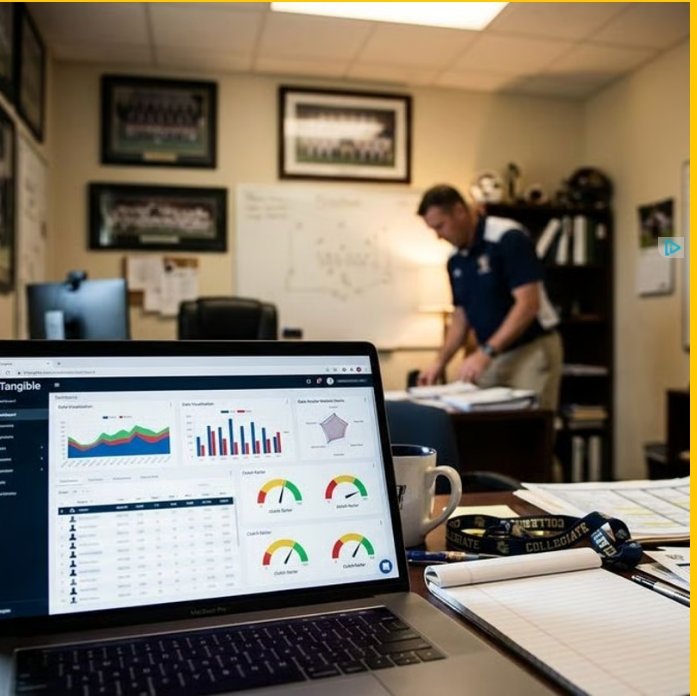
NTangible's core product is the Clutch Factor assessment, a psychological test designed to predict how an athlete performs under pressure. Co-founder and CEO Dan Connerty, a former professional baseball player, built it with Dr. Ed Levine, a psychologist and professor emeritus at the University of South Florida.
The method borrows from the Thematic Apperception Test. Athletes look at ambiguous images and describe what's happening, who they are in the scene and what comes next. There are no right answers. Instead, the words an athlete chooses and how they phrase them are scored against a neurolinguistic guide developed by psychologists, producing a score from 0 to 1,000.
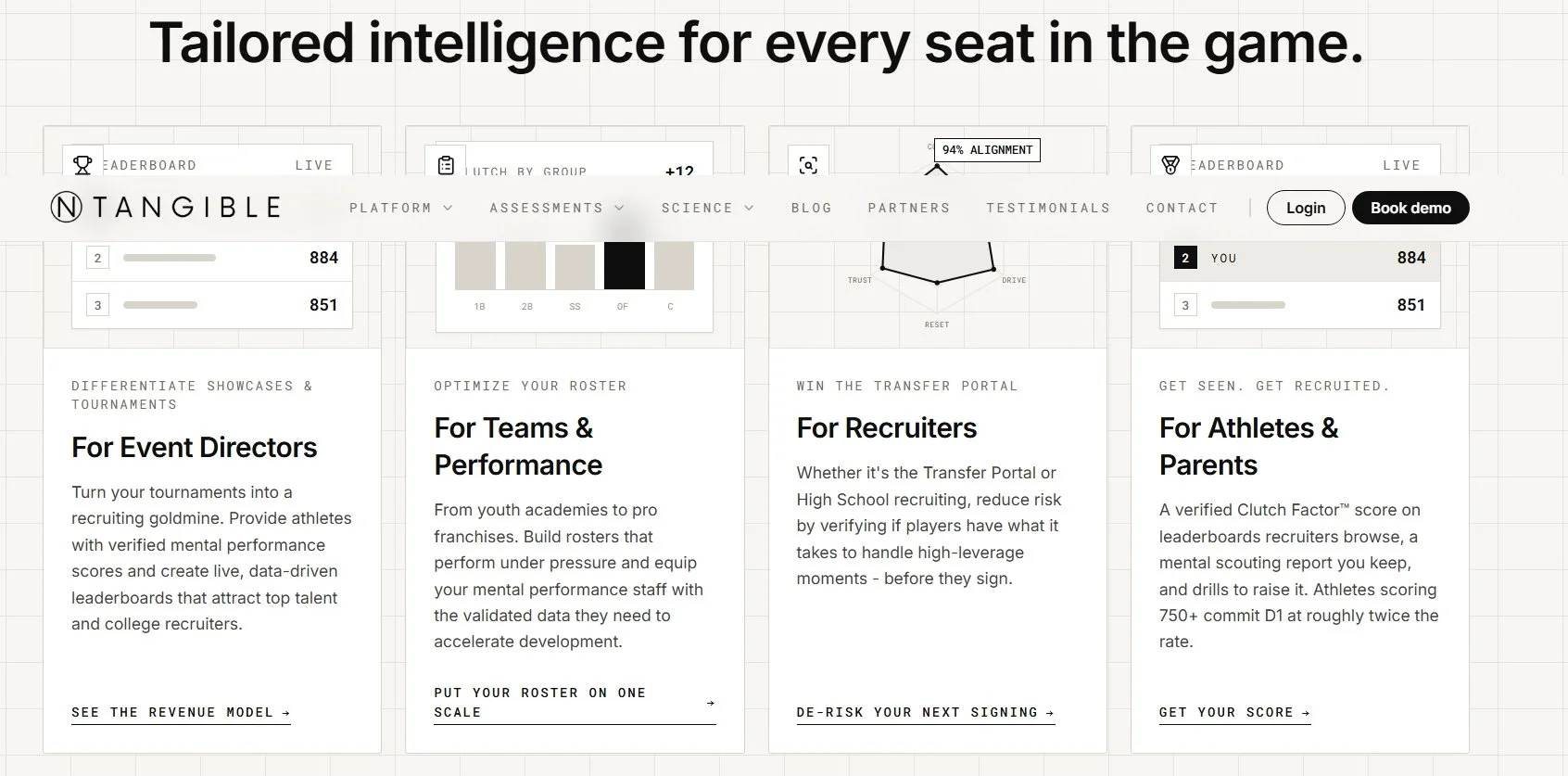
According to Connerty, athletes who score above 750 are twice as likely to commit to a Division I program. The platform now supports nine sports, and NTangible has worked with former MLB sports psychologist Howie Schwartz on a set of exercises athletes can use to start building their mental game. Connerty's view is that clutch is trainable, not fixed.
There's also a play beyond sports. A second assessment, NTerpret, looks at how a person responds to coaching and feedback, which translates directly to how managers develop people inside companies.
Why this matters right now
College sports has quietly become a capital allocation business. With revenue sharing and NIL, programs are writing seven-figure checks to individual athletes; Connerty pointed to quarterbacks commanding $4 million. When the dollars get that big, recruiting stops being a gut-feel exercise and starts looking like underwriting.
The physical side of that underwriting is already well served. Velocity, speed, strength and biomechanics are measured, tracked and benchmarked everywhere. The mental side, the thing every coach says separates good from great, is still mostly anecdote and film. Whoever credibly prices that variable gets a seat in recruiting conversations, rankings, scholarship decisions and NIL negotiations.
That's a real wedge, and it's why I think NTangible belongs in the same conversation as the performance data companies that have reshaped scouting over the last decade.
The honest question: can it be gamed?
TechCrunch's reporter ran the obvious test. Answering honestly, she scored below average. Retaking it while answering the way she imagined a composed, elite recruit would, she scored in the 800s. Any self-reported assessment faces this, and buyers will ask about it.
My read is that this shapes the go-to-market more than it threatens the product:
Administer it inside the organization, not on the open market. A test taken in a controlled program setting, alongside coaches who know the athlete, is much harder to game than a public quiz.
Lead with development, not just selection. The strongest use case may be giving coaches a language for each athlete's mental profile and a plan to improve it. That's a recurring relationship, not a one-time screen.
Build the validation dataset. The long-term moat is tying scores to real high-leverage outcomes over seasons. That evidence is what turns an interesting score into a trusted one.
The commercial read
From where I sit, working at the intersection of sports properties, technology and capital, the business model points clearly toward organizations rather than individual athletes. The natural buyers are college athletic departments and recruiting staffs, NIL collectives deciding where to put money, pro scouting and player development departments, and elite academies and club programs. NTerpret opens a parallel enterprise lane with HR and leadership teams.
The things I'll be watching: published validation data, how cleanly the score plugs into the recruiting and development workflows teams already run, and which early partners are willing to put their names behind it. A Battlefield finalist slot is a great signal. Reference customers are what close the next deal.
Bottom line
Every athlete I ever played with knew who wanted the ball in the ninth and who didn't. Sports has just never had a number for it. If NTangible can prove its score holds up, it won't just be a new metric. It will be a new line item in how programs evaluate and invest in talent.
Disclosure: Sports Tech Atlanta has an advisory relationship with NTangible.
Source: NTangible bets it can predict how athletes will perform under pressure, Amanda Silberling, TechCrunch, Oct. 14, 2026.
Sports Tech Atlanta helps sports properties, athletes and sports-tech companies with partnerships, go-to-market and investor relations. If you're building in this space or evaluating tools like this for your program, reach out.