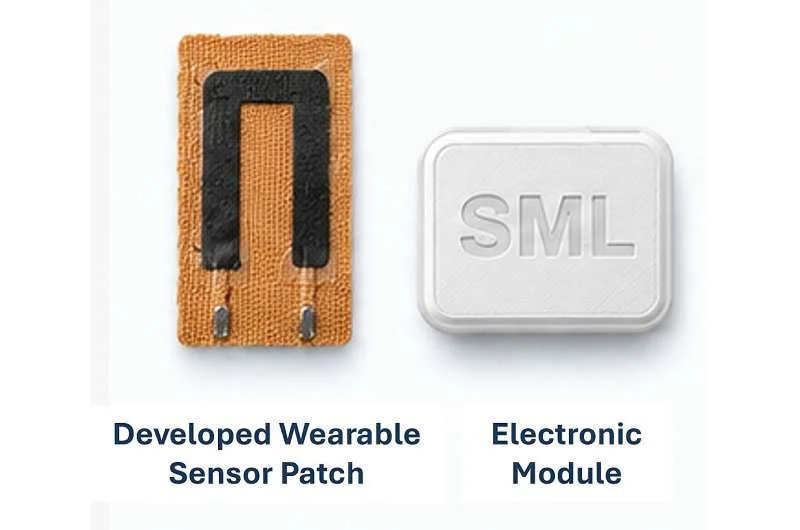
Researchers in India have built a skin-patch sensor that reads how athletes move and grades it against expert patterns. The tech is early, but the commercial question it raises — who pays for coaching at scale — is the one that matters.
Researchers at the Indian Institute of Technology Gandhinagar (IITGN) are testing a wearable sensor that tracks body movement during training and uses machine learning to compare each rep against how experienced athletes and coaches perform the same motion. The team has trialed it across weightlifting, strength training, tennis and swimming, has a patent filing in progress, and is now actively looking for fitness centers, sports academies, trainers and industry partners to take it further.
Here's what they've built, where it stands, and why it's worth watching for anyone selling into the training and performance market.
What the sensor does
The system uses small, flexible patches placed on targeted parts of the body. As a joint bends or a muscle stretches, the patch converts that physical deformation into an electrical signal and streams it over Bluetooth to a phone for analysis.
From there, a machine-learning model looks at three things across a set: timing, strength and consistency of each repetition. It then benchmarks those signals against a library of movement patterns recorded from experienced athletes, coaches and trainers.
The team has packaged the sensor, data capture and analytics into a single platform rather than shipping hardware and leaving the interpretation to someone else.
The problem it's aimed at
The pitch is simple and familiar to anyone who has walked into a busy gym. A good coach can spot a bad bicep curl instantly — but nobody can watch every rep of every athlete in a crowded room. Associate professor Biswajit Saha, who leads the work in IITGN's Department of Chemical Engineering, framed the project around exactly that gap: giving coaches a way to examine movement even when they can't see it.
The researchers are careful not to oversell. They note that a different-looking rep isn't automatically a wrong one — body structure, mobility and fatigue all change how people move. The stated goal is to complement coaching with quantitative data, not replace the coach.
Where it stands today
Readiness: The prototype is at Technology Readiness Level 5 — validated in relevant environments, not yet a product. Testing in real training settings is ongoing.
Testing to date: 50 people in weightlifting and strength training, plus 30 trainees across tennis, swimming and other activities.
IP: A patent filing is underway.
Publication: Findings have not yet been published in a peer-reviewed journal, so there are no accuracy figures to evaluate yet.
Go-to-market: The team is openly seeking partners in fitness, sports academies, training and industry for further testing and product development.
Why it matters commercially
1. Coaching is the bottleneck, and software is the lever. The fitness and youth-academy markets have far more athletes than qualified eyes. Any tool that extends one coach's attention across twenty athletes changes the unit economics of a facility. That's the real value proposition here — not the sensor itself.
2. The data moat is the expert library. Patches and Bluetooth are increasingly commoditized. What's defensible is the reference set of "good" movement the model compares against. Whoever builds the deepest, most sport-specific library of expert movement — and secures clean rights to it — owns the category.
3. Wearables vs. video is a live fight. On-body sensors give precise joint-level signals but require athletes to wear something. Computer-vision platforms read biomechanics from footage teams already shoot, with zero hardware. Expect both approaches to compete for the same performance budgets, and expect the winners to be the ones who plug into existing coaching workflows rather than adding a new one.
4. Pilots are the path to market. At TRL 5 with no published results, the next step is credible real-world validation. That means paid or structured pilots with academies, college programs and training facilities — partners who can generate data, prove outcomes and become reference customers. The IITGN team asking publicly for those partners is the clearest signal of where the project goes next.
The bottom line
IITGN's sensor isn't a product yet, and until results are published it's a promising prototype rather than a proven tool. But it's a sharp example of where performance tech is heading: away from raw tracking and toward automated feedback that scales a coach's judgment. For brands, facilities and investors in the space, the questions to ask are the commercial ones — who owns the expert data, how it fits into a coach's day, and which pilot partners can prove it works.
Sports Tech Atlanta advises sports properties, athletes and sports-tech companies on partnerships, go-to-market and capital. If you're building in performance tech and looking for pilot partners, get in touch.
Source: IIT Gandhinagar researchers test wearable sensor using machine learning to track sports performance — Careers360, Oct. 16, 2026; original coverage via TechXplore.