Riviera Was the Tipping Point — and the Money Knows It
Nelly Korda willed in a putt for the ages. Charley Hull came up a shot short again. But the bigger story is the one playing out off the leaderboard: women's golf is finally getting the windows, the purses, and the partners to match its talent.
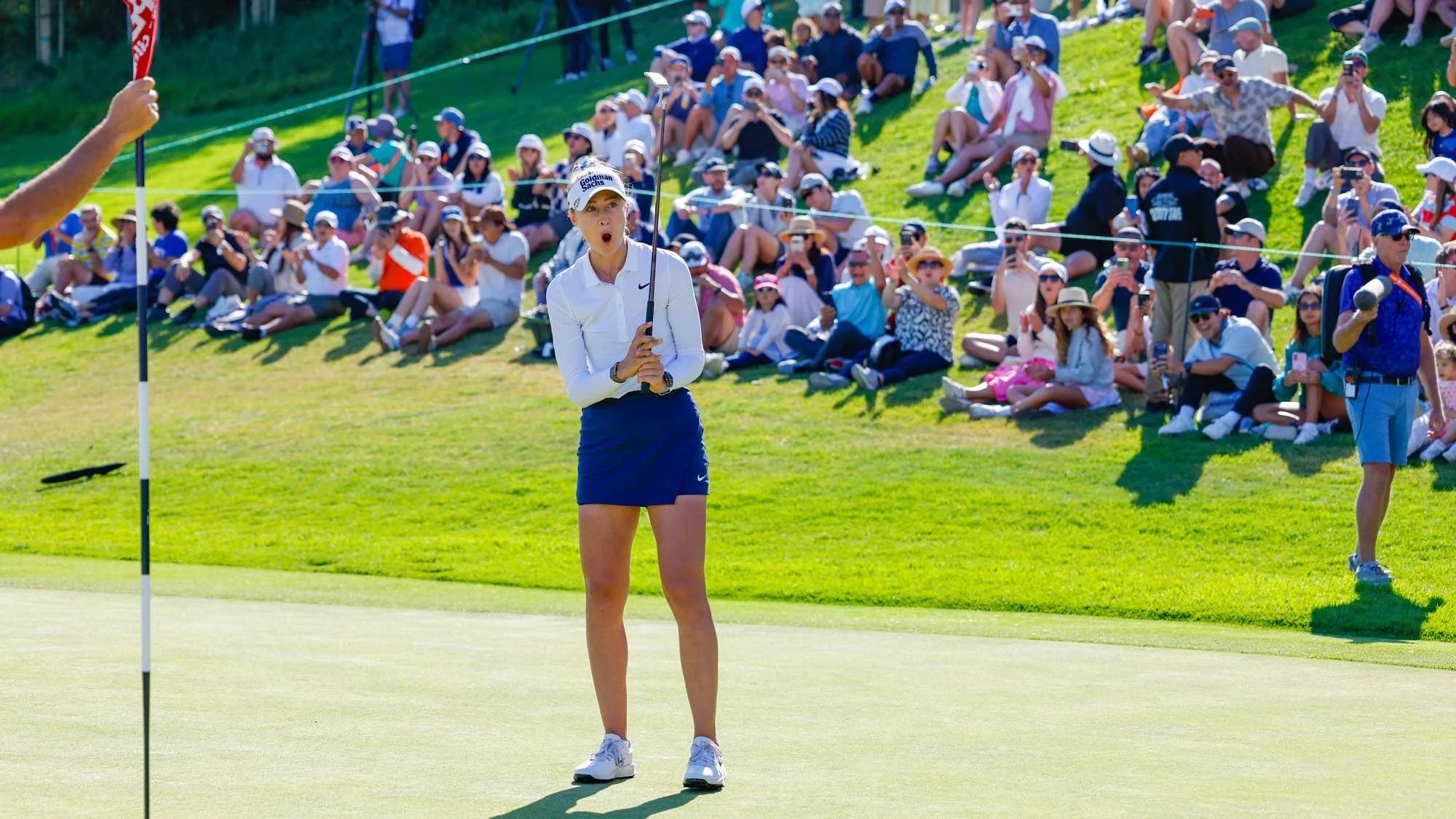
For two feet and ten inches, the 81st U.S. Women's Open hung on the lip of the cup. Nelly Korda's par putt at Riviera circled the rim, threatened to spin out, and then — to a roar from one of the most cinematic amphitheaters in American golf — dropped. World No. 1. Fourth major. One-shot win. Destiny, more or less, on prime time.
It was the kind of finish that sells a sport. And it arrived at exactly the moment women's golf has the infrastructure to capitalize on it.
Korda closed in 69 to finish eight under, holding off a congested, star-laden leaderboard at a venue better known for Hogan and Bogart than for the women's game. The win was worth a record $2.5 million from a record $12.5 million purse — the largest payday in the history of women's major championship golf. It was her fourth victory of 2026 and her second major of the year, making her the first woman since Inbee Park in 2013 to win the season's opening two majors. At 27, she's the youngest American to reach four majors since Mickey Wright in 1960. Only the Evian or the AIG Women's British now stands between her and the career Grand Slam.
The Near-MissCharley Hull keeps writing the most compelling subplot in the game
If Korda is the sport's gravitational center, Charley Hull may be its most marketable story — precisely because the ending keeps eluding her. The Englishwoman authored the round of the weekend, an eagle-laced final-day 67 after a Saturday 65, and at one stage early on the back nine she stood alone at the top. Dropped shots at the 12th and 14th undid it. A clutch sand save at the 17th wasn't quite enough.
It was her fifth runner-up finish in a major, in roughly her 62nd attempt — a tie for second alongside Mexico's Gaby Lopez, one agonizing shot back. The maiden major still hasn't come.
Here's the marketing truth that's easy to miss: a sport doesn't need every star to win. It needs them to be findable and followable. Hull — charismatic, aggressive, a fan favorite who keeps putting herself in the final pairing — is exactly the kind of crossover figure casual audiences latch onto. The near-miss isn't a failure of the product. It's a reason to tune in next time.
"Women's golf doesn't need to prove it has stars. It needs enough consistent exposure for casual fans to learn their stories."
The Real HeadlineThe exposure problem is finally being solved
For years, women's golf was trapped in a maddening loop: it needed attention to earn better broadcast windows, and better windows to earn more attention. In 2026, that loop is breaking. For the first time in tour history, every LPGA event and every round is positioned for live national coverage — a genuinely new era of broadcast distribution built around Golf Channel, a new title-sponsor era, and Trackman-driven production.
That matters because rhythm precedes loyalty. When players are visible week to week, fans build habits, stars become familiar, and — this is the part the sponsors care about — media value becomes measurable and repeatable. The macro data backs it up: Nielsen logged roughly 46 billion minutes of women's sports consumed in the U.S. in 2025, and the LPGA's 2025 season carried a record prize fund of around $131 million across 32 events. The audience and the dollars are both moving in the same direction at the same time. That's rare, and it's the condition under which categories take off.
The European EngineWhy the LET is the most underrated growth story in the sport
Most of the U.S. coverage will fixate on the LPGA. But the more interesting commercial signal is coming from the Ladies European Tour, which has quietly engineered the most aggressive expansion of its 48-year history.
For the 2026 season, the LET will play for a record prize fund of more than €40 million — the first time it has ever crossed that threshold — across 30 events in 21 countries and five continents. A third of those events now carry purses of at least €1 million; ten events raised their purses year over year. Golf Saudi's PIF Global Series climbed to $15 million, the Aramco Championship is co-sanctioned with the LPGA, and the calendar added a new event in Mauritius and welcomed back the Women's Australian Open. The season culminates in the 20th Solheim Cup, in the Netherlands.
Read those numbers as a brand strategist, not a fan. A global footprint across 21 markets is an inventory story. Co-sanctioning with the LPGA is a reach-multiplier. Rising purses signal that promoters and title sponsors are underwriting the category, not subsidizing it out of goodwill. And players like Hull, Lottie Woad, and Mimi Rhodes give the tour a roster of recognizable, English-speaking faces at precisely the moment global broadcast appetite for women's sport is spiking.
The Honest CaveatMomentum is real. Inevitability is not.
A word of discipline before anyone declares victory. Women's golf has had "breakthrough" moments before that didn't compound — U.S. Women's Open TV ratings, in particular, have swung hard year to year depending on venue, finish, and whether the marquee names made the weekend. Record purses are partly fueled by a concentrated set of backers (Golf Saudi chief among them), which is leverage and risk in the same line item. And "positioned for live coverage" is not the same as audiences actually showing up.
The take-off thesis is credible. It is not automatic. What converts this window into a step-change is execution: consistent storytelling around the stars, brand partners who activate rather than just sponsor, and tournaments that treat the broadcast as the beginning of the relationship with a fan, not the end of it.
Where the advisory opportunity actually sits
The capital and the eyeballs are arriving together. The gap — and the value we help clients close — is in the connective tissue between the two. A few places we're watching:
- Athlete-led brand equity. Hull-type figures are undervalued relative to their crossover appeal. The window to lock in athlete partnerships at pre-take-off pricing is closing.
- Global inventory, local activation. A 21-country LET footprint is only as valuable as the activation built on top of it. That's a strategy problem, not a media-buy problem.
- Sponsor durability. Categories that take off on a narrow set of backers are fragile. Diversifying the partner base is the difference between a moment and a market.
- Tech as the differentiator. Production tech, data, and second-screen experiences are how women's golf converts new live windows into retained audiences — the exact intersection STA was built for.
The leaderboard at Riviera will be a footnote in a month. The infrastructure being built around it won't be.
Korda got her putt to drop. Hull will get another shot at hers. And for the first time in a long time, the business behind both of them looks ready to make the most of it.