
The Sports-Tech Matchmaker: Why the Right Introduction Can Matter More Than Another Demo

Sports technology doesn't have a shortage of innovation. It has a discovery problem.

The sports technology industry has a familiar challenge. Founders build products designed to improve athlete performance, modernize fan engagement, streamline operations, or create new revenue opportunities. They attend conferences, send outreach emails, book demonstrations, and work to get their solutions in front of professional teams, leagues, colleges, and sports organizations.

Yet many promising technologies struggle to move from an initial conversation to a meaningful commercial relationship.

The problem isn't always the product. Sometimes, it's the process.

Sports organizations face an increasingly crowded marketplace of technology providers. Decision-makers are asked to evaluate solutions across analytics, artificial intelligence, athlete health, fan engagement, ticketing, sponsorship, media, and operations. Each category contains multiple vendors promising to solve important problems.

For a team executive or athletic department, identifying the right solution can become a project of its own. For a startup, figuring out which organization has a relevant need, who owns the decision, and how to reach that person can be equally challenging.

The next competitive advantage in sports technology may not be another product. It may be a better way to connect the right products with the right buyers.

The gap between innovation and adoption

Sports technology companies often approach business development as a numbers game. More emails, more meetings, more conference appearances, and more product demonstrations should eventually produce commercial results.

Those activities can be valuable. But they don't necessarily address the underlying problem: whether a technology provider is reaching an organization with a relevant need at the right time.

A performance analytics platform might be an excellent solution for a program that is actively reviewing its athlete monitoring capabilities. The same pitch may receive little attention from a department focused on facility upgrades, staffing, or an entirely different set of priorities.

The difference is not necessarily the technology. It is the alignment between the solution and the buyer's immediate objectives.

Successful commercialization requires more than identifying organizations that could theoretically use a product. It requires understanding their needs, recognizing relevant buying signals, identifying the appropriate decision-makers, and creating a credible path toward evaluation.

This is particularly important in sports, where purchasing decisions can involve coaches, athletic directors, technology leaders, medical personnel, commercial executives, procurement teams, and external partners.

A product may solve a real problem without ever reaching the person responsible for addressing it.

Sports organizations have a discovery problem, too

The challenge is not limited to startups.

Teams, leagues, colleges, and governing bodies need ways to evaluate the growing range of technology available to them. Their objectives may include improving athlete availability, increasing ticket revenue, developing new sponsorship inventory, creating better digital experiences, or operating more efficiently.

Finding solutions through existing networks and referrals remains valuable. Industry conferences can also create opportunities for discovery. But neither approach guarantees that the most relevant provider will be identified.

The result is a two-sided challenge.

Technology companies need a more efficient way to identify commercial opportunities. Sports organizations need a more structured way to discover solutions that align with their priorities.

A better matchmaking process should serve both sides rather than simply giving vendors another directory of potential prospects.

From cold outreach to opportunity-driven connections

Imagine a different approach.

Instead of starting with a list of hundreds of teams and sending each the same introductory message, a technology company begins by identifying an organization with a specific need.

A college athletic department is exploring athlete monitoring. A professional team is reviewing its fan engagement strategy. A league is looking for ways to improve its commercial data capabilities. A sports property is seeking technology to help demonstrate sponsorship value.

Each opportunity provides a more meaningful starting point for a conversation.

The technology provider can assess whether its product fits the stated need, prepare relevant evidence, and approach the organization with a clearer value proposition. The prospective buyer, meanwhile, can evaluate solutions against an actual business objective rather than a generic sales pitch.

This approach does not eliminate the need for relationship building, due diligence, demonstrations, or procurement. It makes those activities more purposeful.

The objective is to move from indiscriminate outreach toward opportunity-driven business development.

Why matchmaking needs more than artificial intelligence

Artificial intelligence can help organize information, surface relevant solutions, and identify potential connections across a complex market. It can make discovery more efficient, especially when buyers and sellers are working across different sports, technology categories, and geographies.

But matching algorithms alone are not enough.

A credible matchmaking process needs to account for the buyer's actual requirements, the provider's capabilities, the evidence supporting its claims, and the practical considerations involved in implementation.

Does the provider have relevant experience? Can it integrate with existing systems? Is the solution appropriate for the organization's budget and resources? Is there a clear business case? Who needs to be involved in the decision?

These questions separate a potentially interesting connection from a commercially viable opportunity.

Technology can improve discovery, but context and relationships remain essential to converting a match into a partnership.

Building a better path from discovery to commercial results

At Sports Tech Atlanta, this challenge sits at the intersection of sports technology, commercial strategy, and relationship development.

The Sports Tech Atlanta MatchMaker is designed to help sports organizations discover relevant solutions and help technology companies connect with potential opportunities. Organizations can submit projects or requests for proposals, while technology providers can share their capabilities and identify potential matches.

The goal is to create a more structured connection between demand and supply, reducing some of the friction that makes sports-tech commercialization difficult.

Learn more at Sports Tech Atlanta and explore the STA Projects to understand the types of opportunities and initiatives within the network.

For sports organizations, the opportunity is to make technology discovery more targeted. For founders, it is to spend less time pursuing disconnected prospects and more time building relationships around identifiable needs.

Neither side can eliminate the complexities of purchasing and implementing technology. But both can benefit from a more informed starting point.

The future belongs to companies that can connect innovation to demand

Sports technology will continue to evolve. New products will emerge, established platforms will expand, and artificial intelligence will create new possibilities across the industry.

The commercial challenge will remain: How does the right technology reach the right organization at the right moment?

The companies that answer that question effectively will have an advantage beyond the quality of their products. They will understand their buyers, recognize market demand, and build relationships that move beyond demonstrations toward implementation.

The same principle applies to the organizations evaluating those solutions. Better discovery can lead to better-informed decisions and a clearer connection between technology investment and organizational objectives.

Sports doesn't need more introductions for the sake of introductions. It needs more relevant conversations that lead somewhere.

The next big opportunity in sports tech may begin not with another demo, but with the right match.

Are you a sports organization looking for technology solutions, or a founder seeking commercial opportunities in sports? Connect with Sports Tech Atlanta to explore the network and learn more about the MatchMaker.
IIT Gandhinagar's Wearable Sensor Wants to Watch Every Rep

Researchers in India have built a skin-patch sensor that reads how athletes move and grades it against expert patterns. The tech is early, but the commercial question it raises — who pays for coaching at scale — is the one that matters.

Researchers at the Indian Institute of Technology Gandhinagar (IITGN) are testing a wearable sensor that tracks body movement during training and uses machine learning to compare each rep against how experienced athletes and coaches perform the same motion. The team has trialed it across weightlifting, strength training, tennis and swimming, has a patent filing in progress, and is now actively looking for fitness centers, sports academies, trainers and industry partners to take it further.

Here's what they've built, where it stands, and why it's worth watching for anyone selling into the training and performance market.

What the sensor does

The system uses small, flexible patches placed on targeted parts of the body. As a joint bends or a muscle stretches, the patch converts that physical deformation into an electrical signal and streams it over Bluetooth to a phone for analysis.

From there, a machine-learning model looks at three things across a set: timing, strength and consistency of each repetition. It then benchmarks those signals against a library of movement patterns recorded from experienced athletes, coaches and trainers.

The team has packaged the sensor, data capture and analytics into a single platform rather than shipping hardware and leaving the interpretation to someone else.

The problem it's aimed at

The pitch is simple and familiar to anyone who has walked into a busy gym. A good coach can spot a bad bicep curl instantly — but nobody can watch every rep of every athlete in a crowded room. Associate professor Biswajit Saha, who leads the work in IITGN's Department of Chemical Engineering, framed the project around exactly that gap: giving coaches a way to examine movement even when they can't see it.

The researchers are careful not to oversell. They note that a different-looking rep isn't automatically a wrong one — body structure, mobility and fatigue all change how people move. The stated goal is to complement coaching with quantitative data, not replace the coach.

Where it stands today

  • Readiness: The prototype is at Technology Readiness Level 5 — validated in relevant environments, not yet a product. Testing in real training settings is ongoing.

  • Testing to date: 50 people in weightlifting and strength training, plus 30 trainees across tennis, swimming and other activities.

  • IP: A patent filing is underway.

  • Publication: Findings have not yet been published in a peer-reviewed journal, so there are no accuracy figures to evaluate yet.

  • Go-to-market: The team is openly seeking partners in fitness, sports academies, training and industry for further testing and product development.

Why it matters commercially

1. Coaching is the bottleneck, and software is the lever. The fitness and youth-academy markets have far more athletes than qualified eyes. Any tool that extends one coach's attention across twenty athletes changes the unit economics of a facility. That's the real value proposition here — not the sensor itself.

2. The data moat is the expert library. Patches and Bluetooth are increasingly commoditized. What's defensible is the reference set of "good" movement the model compares against. Whoever builds the deepest, most sport-specific library of expert movement — and secures clean rights to it — owns the category.

3. Wearables vs. video is a live fight. On-body sensors give precise joint-level signals but require athletes to wear something. Computer-vision platforms read biomechanics from footage teams already shoot, with zero hardware. Expect both approaches to compete for the same performance budgets, and expect the winners to be the ones who plug into existing coaching workflows rather than adding a new one.

4. Pilots are the path to market. At TRL 5 with no published results, the next step is credible real-world validation. That means paid or structured pilots with academies, college programs and training facilities — partners who can generate data, prove outcomes and become reference customers. The IITGN team asking publicly for those partners is the clearest signal of where the project goes next.

The bottom line

IITGN's sensor isn't a product yet, and until results are published it's a promising prototype rather than a proven tool. But it's a sharp example of where performance tech is heading: away from raw tracking and toward automated feedback that scales a coach's judgment. For brands, facilities and investors in the space, the questions to ask are the commercial ones — who owns the expert data, how it fits into a coach's day, and which pilot partners can prove it works.

Sports Tech Atlanta advises sports properties, athletes and sports-tech companies on partnerships, go-to-market and capital. If you're building in performance tech and looking for pilot partners, get in touch.

Source: IIT Gandhinagar researchers test wearable sensor using machine learning to track sports performance — Careers360, Oct. 16, 2026; original coverage via TechXplore.

Can You Measure Clutch?

NTangible is betting the last unpriced variable in recruiting is what happens between an athlete's ears. Here's why that bet matters, and what has to be true for it to pay off.


The at-bat nobody scouts

I played Division I baseball at Indiana. Every scout who ever watched me could tell you my sixty time, my arm strength and what I did against a fastball. None of them could tell you what my heart rate was doing with two outs, runners on, and the season on the line. That was the part of the game that actually decided careers, and it was the part nobody could measure.

That's the gap NTangible is going after, and this week it put that thesis in front of the biggest startup stage in tech. TechCrunch profiled the company ahead of its pitch as one of the top 20 finalists in Startup Battlefield at TechCrunch Disrupt 2026 in San Francisco.

What NTangible is building

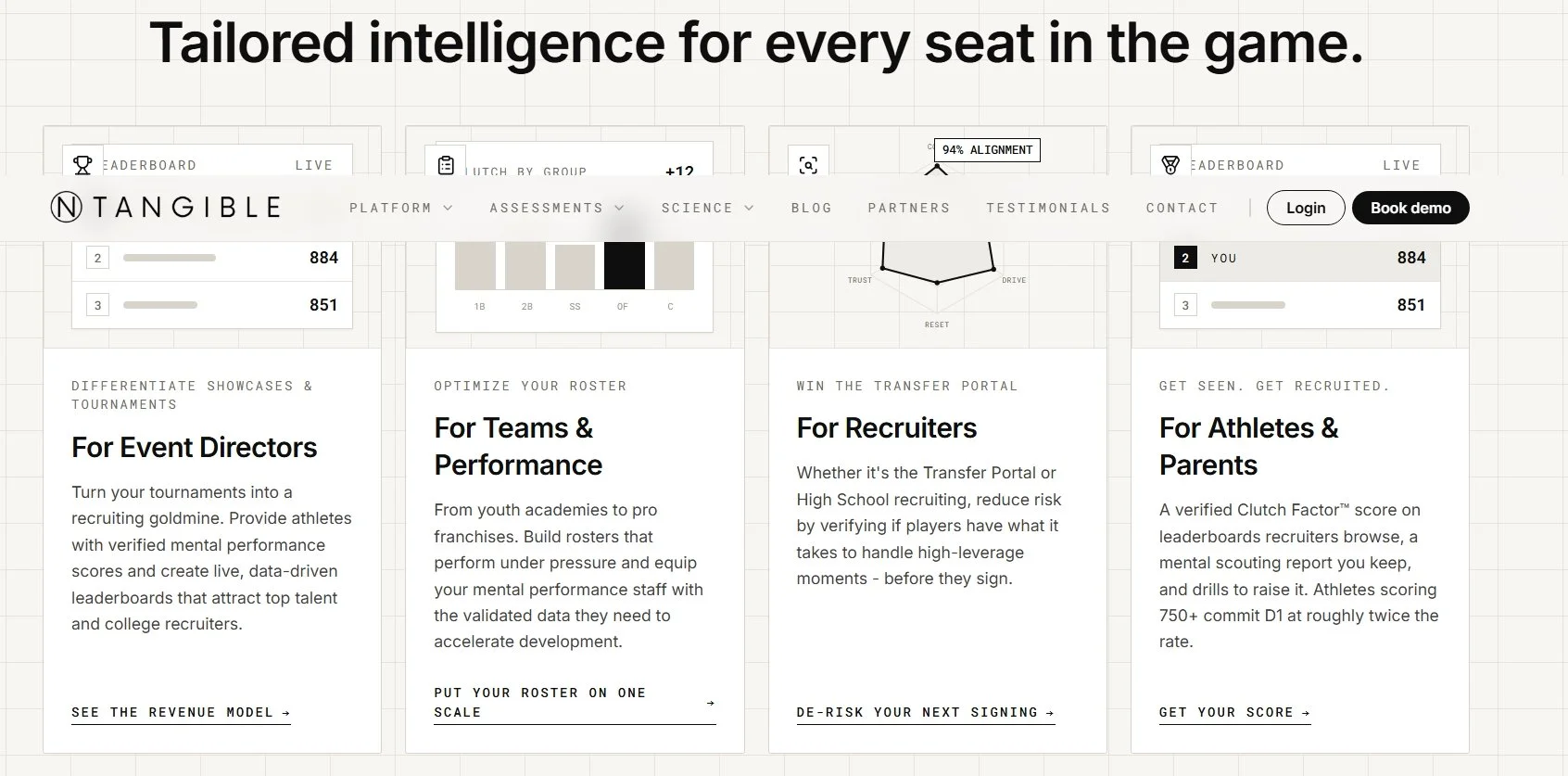
NTangible's core product is the Clutch Factor assessment, a psychological test designed to predict how an athlete performs under pressure. Co-founder and CEO Dan Connerty, a former professional baseball player, built it with Dr. Ed Levine, a psychologist and professor emeritus at the University of South Florida.

The method borrows from the Thematic Apperception Test. Athletes look at ambiguous images and describe what's happening, who they are in the scene and what comes next. There are no right answers. Instead, the words an athlete chooses and how they phrase them are scored against a neurolinguistic guide developed by psychologists, producing a score from 0 to 1,000.

According to Connerty, athletes who score above 750 are twice as likely to commit to a Division I program. The platform now supports nine sports, and NTangible has worked with former MLB sports psychologist Howie Schwartz on a set of exercises athletes can use to start building their mental game. Connerty's view is that clutch is trainable, not fixed.

There's also a play beyond sports. A second assessment, NTerpret, looks at how a person responds to coaching and feedback, which translates directly to how managers develop people inside companies.

Why this matters right now

College sports has quietly become a capital allocation business. With revenue sharing and NIL, programs are writing seven-figure checks to individual athletes; Connerty pointed to quarterbacks commanding $4 million. When the dollars get that big, recruiting stops being a gut-feel exercise and starts looking like underwriting.

The physical side of that underwriting is already well served. Velocity, speed, strength and biomechanics are measured, tracked and benchmarked everywhere. The mental side, the thing every coach says separates good from great, is still mostly anecdote and film. Whoever credibly prices that variable gets a seat in recruiting conversations, rankings, scholarship decisions and NIL negotiations.

That's a real wedge, and it's why I think NTangible belongs in the same conversation as the performance data companies that have reshaped scouting over the last decade.

The honest question: can it be gamed?

TechCrunch's reporter ran the obvious test. Answering honestly, she scored below average. Retaking it while answering the way she imagined a composed, elite recruit would, she scored in the 800s. Any self-reported assessment faces this, and buyers will ask about it.

My read is that this shapes the go-to-market more than it threatens the product:

  • Administer it inside the organization, not on the open market. A test taken in a controlled program setting, alongside coaches who know the athlete, is much harder to game than a public quiz.

  • Lead with development, not just selection. The strongest use case may be giving coaches a language for each athlete's mental profile and a plan to improve it. That's a recurring relationship, not a one-time screen.

  • Build the validation dataset. The long-term moat is tying scores to real high-leverage outcomes over seasons. That evidence is what turns an interesting score into a trusted one.


The commercial read

From where I sit, working at the intersection of sports properties, technology and capital, the business model points clearly toward organizations rather than individual athletes. The natural buyers are college athletic departments and recruiting staffs, NIL collectives deciding where to put money, pro scouting and player development departments, and elite academies and club programs. NTerpret opens a parallel enterprise lane with HR and leadership teams.

The things I'll be watching: published validation data, how cleanly the score plugs into the recruiting and development workflows teams already run, and which early partners are willing to put their names behind it. A Battlefield finalist slot is a great signal. Reference customers are what close the next deal.

Bottom line

Every athlete I ever played with knew who wanted the ball in the ninth and who didn't. Sports has just never had a number for it. If NTangible can prove its score holds up, it won't just be a new metric. It will be a new line item in how programs evaluate and invest in talent.

Disclosure: Sports Tech Atlanta has an advisory relationship with NTangible.

Source: NTangible bets it can predict how athletes will perform under pressure, Amanda Silberling, TechCrunch, Oct. 14, 2026.

Sports Tech Atlanta helps sports properties, athletes and sports-tech companies with partnerships, go-to-market and investor relations. If you're building in this space or evaluating tools like this for your program, reach out.

5 Sports Tech Products to Watch: The New Wave of AI Coaching, Wearables and Athlete Development

From lower-body movement tracking to AI-powered training apps, these five products offer a glimpse into how technology is changing the way athletes train, compete and recover.

Sports technology doesn't always arrive in the form of a billion-dollar platform or a major league partnership. Sometimes, the most interesting innovations are products that solve a specific problem for athletes, coaches or everyday sports enthusiasts.

From wearables that look beyond your wrist to AI tools that turn a smartphone into a training assistant, a new generation of sports tech companies is rethinking what performance technology can look like.

Here are five products worth watching.

1. upLYFT A1: A Different Way to Measure Athletic Movement

The idea: Go beyond heart rate and recovery scores.

Most consumer wearables focus on familiar metrics such as heart rate, sleep and activity. upLYFT is taking a different approach with its A1 Performance Track Band, introduced in September 2026.

The wearable is designed to analyze movement across the lower body, helping athletes build a more detailed picture of how they move during training.

Why it matters: Athletic performance isn't just about how hard an athlete works. How they move, distribute force and repeat movements can also influence performance and training decisions.

The opportunity for sports tech is making insights that once required specialized facilities more accessible to athletes and coaches.

The takeaway: The next evolution of wearables may focus less on counting what athletes do and more on understanding how they do it.

Explore upLYFT

2. PEPPER: Bringing Electrical Muscle Stimulation Into the Workout

The idea: Rethink the traditional strength-training session.

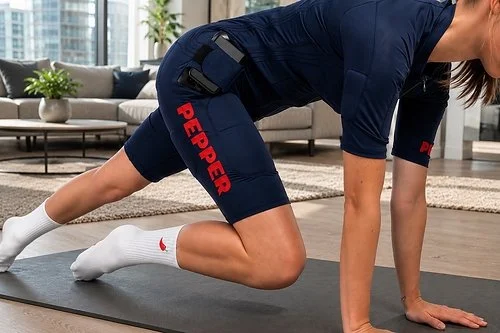
PEPPER announced its U.S. launch in June 2026 with a wireless Muscle Activation Suit that uses electrical muscle stimulation (EMS) alongside a guided training app.

The concept combines wearable technology and structured workouts to deliver a different approach to strength training. The company markets a 20-minute session as comparable to a longer conventional workout, although individual results will vary and the claim should be evaluated in context.

Why it matters: Fitness technology increasingly focuses on making training more accessible, personalized and convenient. Wearable systems that combine hardware, software and coaching could appeal to people who want structured workouts without relying exclusively on traditional gym equipment.

For the sports industry, the interesting question is how these systems might complement existing strength and conditioning programs.

The takeaway: The gym experience is expanding beyond racks, weights and machines into connected, wearable training systems.

Read the PEPPER launch announcement

3. Mojawa Purra Flow: Your Headphones Become Your Coach

The idea: Combine audio, heart-rate monitoring and real-time training guidance.

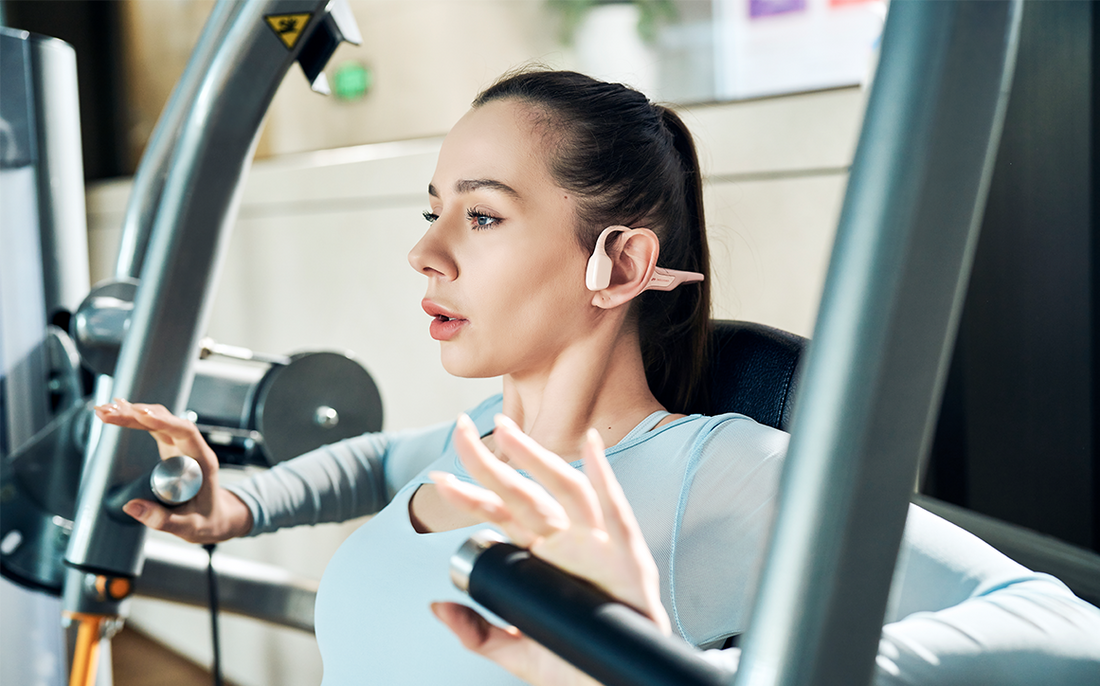
Mojawa introduced Purra Flow in July 2026, bringing AI coaching features to bone-conduction sports headphones.

The product combines open-ear audio, heart-rate monitoring, onboard music storage and voice-based workout guidance. It is designed for activities including running, cycling and swimming.

Instead of repeatedly checking a watch or phone, athletes can receive prompts intended to help them manage workout intensity while staying focused on the activity.

Why it matters: Wearables are becoming more than passive data collectors. The next step is turning information into timely guidance that athletes can actually use while moving.

Audio may be an especially useful interface because it can deliver feedback without requiring an athlete to stop and look at a screen.

The takeaway: The next wearable breakthrough may not be another screen. It may be a smarter coach in your ears.

Explore Mojawa

4. HoloSport SollaWave: Making Swimming More Connected

The idea: Bring entertainment and training feedback into the pool.

Swimming presents a unique challenge for consumer technology. Athletes are surrounded by water, often separated from their phones and unable to interact easily with traditional screens.

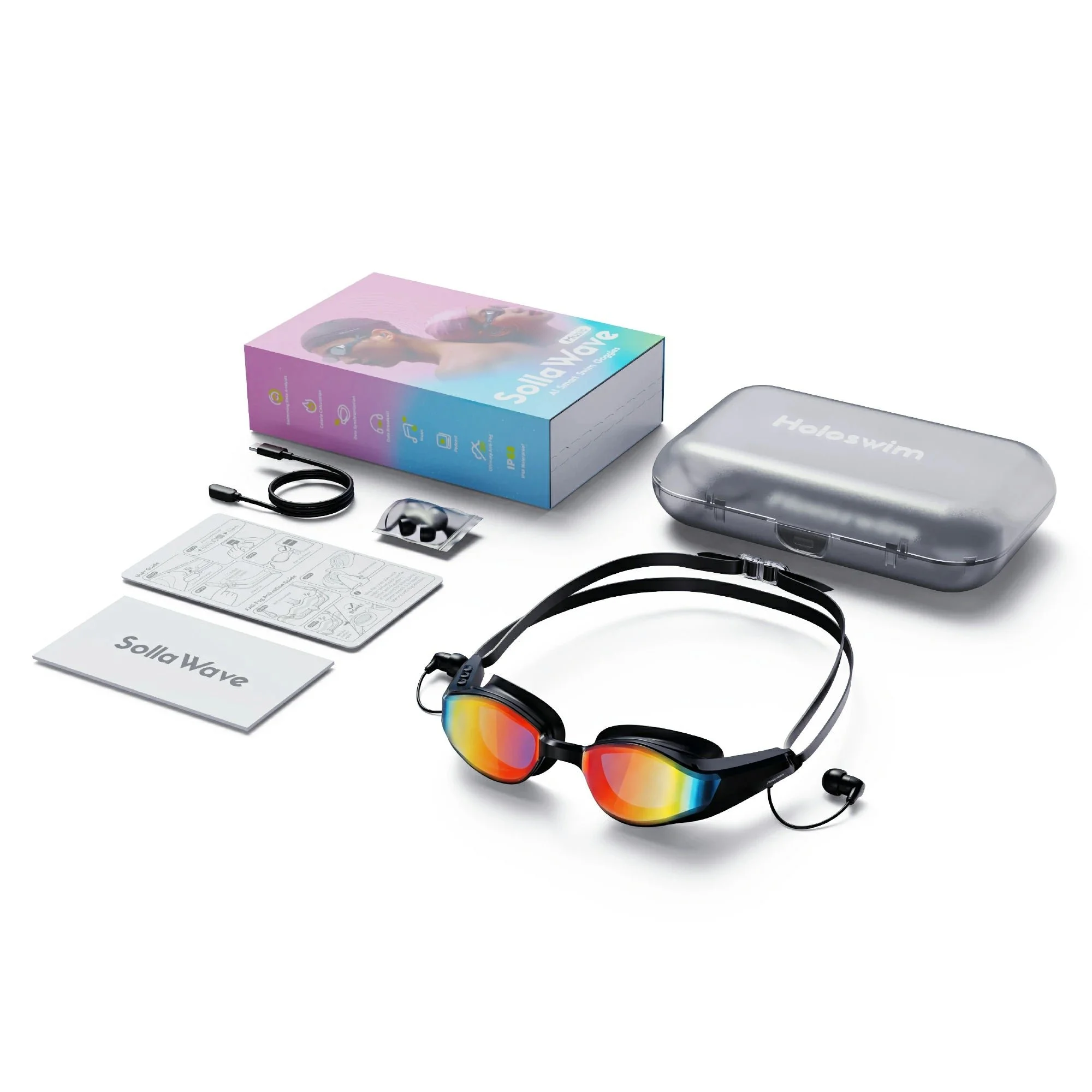
HoloSport announced SollaWave in June 2026, positioning it as a connected swimming product combining goggles, music playback, fitness tracking and accessories designed for the swimming experience.

The broader concept is compelling: making technology more useful in an environment where conventional connected devices are less practical.

Why it matters: Connected fitness has grown across running, cycling and strength training, but swimming requires different hardware and user experiences. Products that address those constraints could make the sport more engaging for recreational swimmers while opening new opportunities for training feedback.

The takeaway: Some of the most interesting sports tech opportunities emerge when companies design specifically for the challenges of an individual sport.

Explore HoloSport

5. Ballogy: AI-Powered Player Development in Your Pocket

The idea: Make training data more accessible to athletes and coaches.

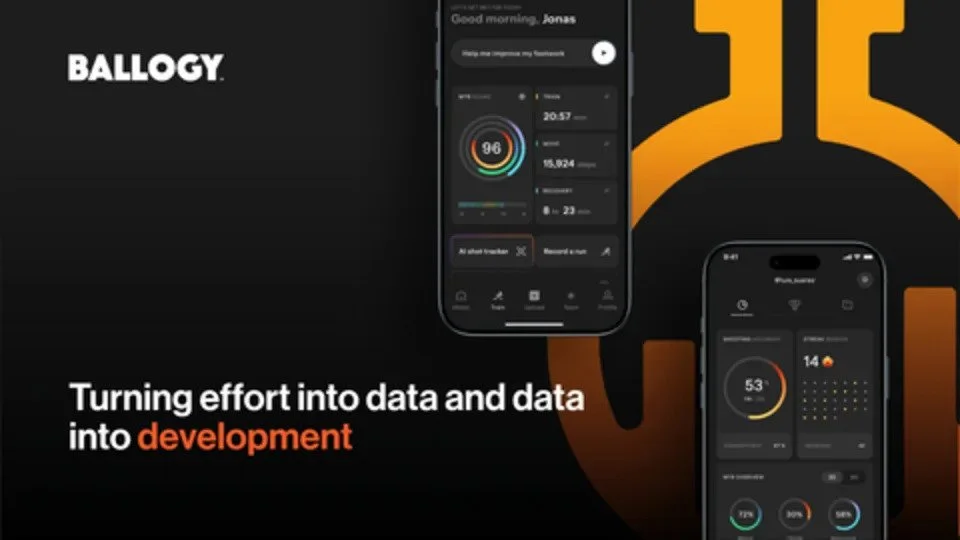
Ballogy launched its new Move, Train, Recover app in August 2026, expanding its approach to athlete development with AI-powered tools, activity tracking and training management.

The platform uses computer vision to track certain sport-specific drills and weight-room repetitions. It also brings activity and recovery information into a broader framework for athlete development.

Why it matters: Advanced performance analysis has traditionally been associated with professional teams, specialized facilities and expensive equipment. Smartphone-based tools offer a different model, potentially bringing structured feedback to youth, amateur and grassroots athletes.

For coaches, the opportunity goes beyond measuring performance. It includes organizing training, assigning activities and helping athletes build consistent development habits.

The takeaway: The future of sports technology isn't just about helping elite athletes get better. It's also about giving more athletes access to better development tools.

Explore Ballogy

The Bigger Picture: Sports Tech Is Becoming More Personal

These five products operate in different parts of the sports technology ecosystem, but they point toward several common themes.

  • AI is becoming a training interface. Technology is moving beyond dashboards and toward tools that provide guidance during workouts.

  • Wearables are becoming more specialized. Rather than relying on one device to measure everything, athletes may increasingly use purpose-built products for particular sports or performance needs.

  • Performance insights are moving closer to the athlete. Smartphone cameras, connected equipment and consumer wearables are expanding access to training information.

  • The experience matters as much as the data. Whether it's listening to music while swimming or receiving feedback without checking a screen, technology must fit naturally into the sport.

Of course, an interesting product is not automatically a proven performance solution. Accuracy, usability, scientific validation, price and adoption will determine which innovations make a lasting impact.

But the direction is worth watching.

For sports organizations, teams, coaches and technology companies, the opportunity is to identify products that solve real problems—not simply add another layer of data.

At Sports Tech Atlanta, we'll continue following the companies and innovations shaping the future of sports.

Which of these five products would you most want to try?

Sports Tech Atlanta covers the technology, companies and ideas changing the business and experience of sports.

Your Calendar Is Becoming the Next Sports Fan Engagement Channel

Sports Tech Atlanta | Sports Technology & Business

Sports organizations have spent years trying to answer the same question:

How do we get closer to the fan?

The answer has traditionally been through social media, email, apps, ticketing platforms, loyalty programs and increasingly personalized digital experiences.

But there is another piece of technology sitting on almost every fan's phone that sports organizations may be underutilizing:

The calendar.

That is where Stanza comes in.

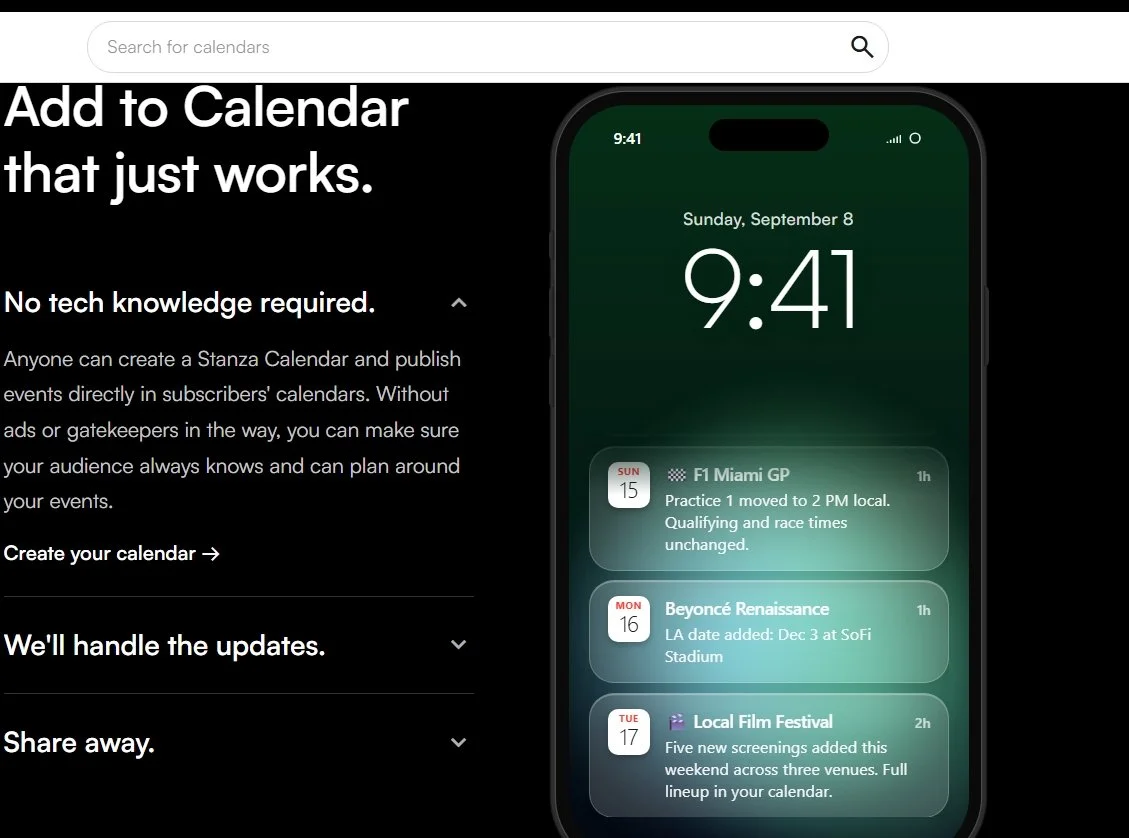
Stanza for Creators allows creators, teams, leagues, publishers and organizations to publish calendars that fans can subscribe to and have automatically updated in their own calendar apps.

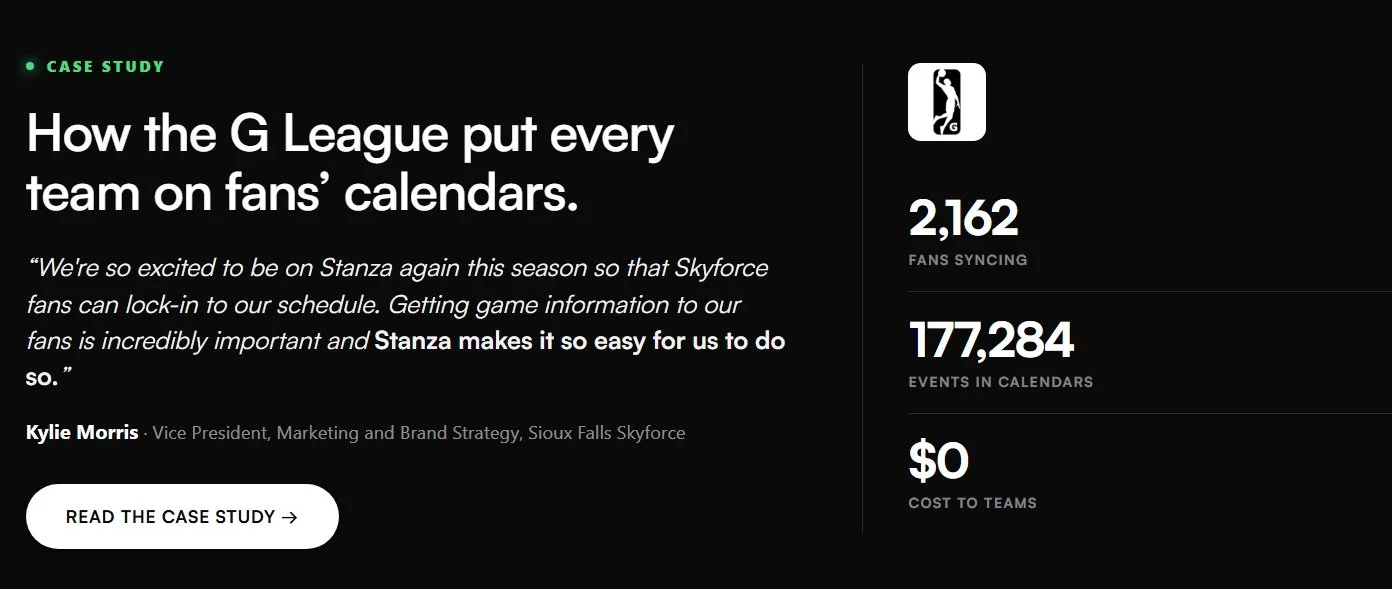
And now, Stanza is making its creator platform available for free.


The Calendar Is More Than a Schedule

For years, a sports schedule has primarily been treated as information.

Here are the games. Here are the dates. Here are the times.

But the schedule can be much more valuable than that.

It can become a direct connection between an organization and its audience.

A fan subscribes once, and the relationship continues throughout the season. Games appear directly on their phone, while updates can flow through when schedules change.

Instead of asking fans to remember to visit a website, open an app or search social media for the next game, the game comes to them.

Think Beyond Games

This is where things get particularly interesting for sports technology.

A team doesn't have to limit its calendar to games.

A calendar could include:

  • Home and away games

  • Ticket on-sale dates

  • Promotional nights

  • Fan events and watch parties

  • Community events

  • Youth clinics

  • Sponsor activations

  • Livestreams

  • Merchandise launches

  • Playoff dates

The calendar becomes another place where an organization can tell the fan what is happening and when.

An Opportunity for Smaller Sports Organizations

The biggest opportunity may not necessarily be the organizations with massive technology budgets.

For a professional league or major university, building a sophisticated mobile application is possible. For a smaller college program, emerging league, niche sport or independent creator, building and maintaining another technology platform can be much more difficult.

Stanza's creator platform lowers that barrier.

Organizations can create or import calendars, distribute them across websites, newsletters and social channels, and allow fans to subscribe directly.

You don't necessarily need another app. You may just need to make the information fans already want easier to access.

Schedule Release Could Become a Marketing Moment

Schedule release is already a major content moment for sports organizations.

But instead of simply announcing:

"Here is our 2027 schedule."

Imagine the call to action being:

"Add the entire 2027 season to your calendar."

A social post can disappear.

An email can get buried.

A website visit ends when the fan leaves.

A calendar subscription can remain on the fan's phone throughout the season.

That makes the calendar an interesting addition to a team's broader digital strategy.

Calendar + CRM

There is another layer worth watching.

Stanza also provides tools for creators to grow their subscriber base and collect fan contact information when people subscribe, subject to applicable privacy requirements.

That creates the potential for the calendar to become more than a scheduling tool.

It could become another fan acquisition and first-party data touchpoint.

The potential funnel starts to look something like:

Schedule announcement → Calendar subscription → Fan contact → CRM → Ticketing → Merchandising → Events → Long-term fan relationship

The calendar itself may be simple.

The infrastructure around the fan relationship is not.

The Bigger Sports Tech Trend

This is part of a broader shift across sports technology.

The next generation of fan engagement isn't necessarily about convincing fans to download another app.

It's about meeting fans where they already are.

Their phones.

Their messaging platforms.

Their social feeds.

Their email inboxes.

Their connected TVs.

And increasingly, their calendars.

That is why seemingly simple infrastructure can become interesting sports technology.

The technology doesn't have to be flashy.

It has to remove friction.

And getting a fan from:

"I want to follow this team."

to:

"Their games are automatically on my calendar."

is a pretty good example of removing friction.

Our Take

At Sports Tech Atlanta, we're particularly interested in technologies that sit at the intersection of sports, technology and business—especially when a relatively simple product can create a new opportunity for teams, leagues, brands and fans.

Stanza fits into that conversation.

The idea isn't revolutionary because calendars are new.

It's interesting because calendar behavior is already deeply embedded in how people organize their lives.

The opportunity is to make the sports schedule part of that behavior.

And with Stanza opening its creator platform for free, the barrier for teams, leagues, publishers and creators to experiment with that idea has become considerably lower.

The next time a sports organization asks:

"How do we get fans to pay attention to our schedule?"

Maybe the answer isn't another notification.

Maybe it's simply:

Put it on their calendar.

Interested in Sports Technology?

Sports Tech Atlanta connects sports organizations, technology companies, brands and innovators across the evolving sports ecosystem.

Explore Sports Tech Atlanta: Sports Tech Atlanta

Explore Stanza for Creators: Publish Your Calendar Free with Stanza